

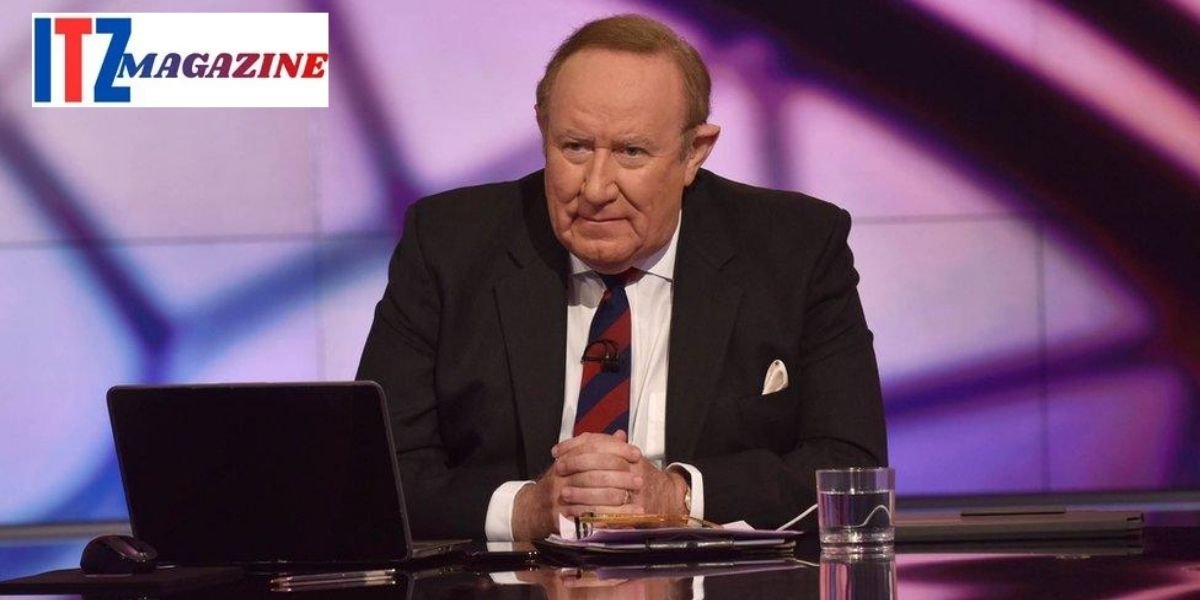
Few figures in British public life have left such an indelible mark on both print and broadcast media as Andrew Neil. For more than five decades, this Paisley-born journalist has combined forensic interviewing, sharp editorial judgement and a refusal to soft-pedal uncomfortable truths. From the newsrooms of The Economist and The Sunday Times to the studios of the BBC, Channel 4 and Times Radio, Andrew Neil has remained a constant presence – admired by many, feared by politicians of every stripe, and rarely ignored.
His career tracks the transformation of British media itself: the end of the closed-shop print unions, the arrival of satellite television, the rise of 24-hour news and the fragmentation of the traditional broadcasting landscape. Through it all, Andrew Neil has stayed true to a straightforward principle – ask the hard questions and demand proper answers.
From Paisley Council Estate to Fleet Street

Andrew Ferguson Neil was born on 21 May 1949 in Paisley, Renfrewshire. His father, James, was an electrician who had served as a Desert Rat in the Second World War; his mother worked in the local cotton mills. The family later moved to a council house in Glenburn, one of Paisley’s post-war housing schemes. It was a solid, Presbyterian, working-class Scottish upbringing that instilled both ambition and a healthy scepticism of establishment complacency.
At Paisley Grammar School he excelled academically and on the cricket field. He went on to the University of Glasgow, reading political economy and political science – the same institution where Adam Smith had once taught. He threw himself into student politics, editing the university newspaper and serving as chairman of the Federation of Conservative Students. After graduating with an MA (Hons) in 1971, he briefly worked as a research assistant for the Conservative Party under Edward Heath before deciding that journalism offered a more direct route to influence.
In 1973 he joined The Economist. Over the next decade he worked as a House of Commons lobby correspondent, White House correspondent in Washington and Wall Street correspondent in New York, eventually becoming British Editor. Those years sharpened his grasp of economics and politics on both sides of the Atlantic and gave him a transatlantic perspective that would serve him well throughout his career.
The Sunday Times Years and the Birth of Sky
In 1983 Rupert Murdoch appointed the relatively young Andrew Neil as editor of The Sunday Times. It was a bold, some said reckless, choice. Neil was not a traditional Fleet Street grandee; he arrived with a reputation for intellectual rigour rather than social connections. Over the next eleven years he transformed the paper into the multi-section powerhouse that still dominates the Sunday market. Investigative journalism flourished. The paper broke major stories, backed Margaret Thatcher’s economic reforms, and embraced the new technology that would ultimately break the print unions’ stranglehold.
Neil was also central to the launch of Sky Television in 1988. As founding chairman he helped Murdoch build Britain’s first multi-channel satellite platform at a time when many in the broadcasting establishment dismissed the project as a folly. The subsequent success of Sky changed the economics of British television forever. By the early 1990s Andrew Neil had become one of the most powerful media executives in the country – and one of the most visible.
His high profile eventually strained relations with Murdoch. In 1994 he left The Sunday Times. The parting was not entirely amicable, yet Neil’s record stood: circulation, influence and commercial strength had all increased dramatically under his editorship.
Twenty-Five Years at the BBC
After a period with the Barclay brothers’ Press Holdings – where he oversaw The Scotsman, Scotland on Sunday and other titles – Andrew Neil returned to the forefront of British broadcasting. In 2003 he began presenting This Week and Daily Politics for the BBC. Over the next seventeen years he became the corporation’s most forensic political interviewer. Party leaders of every colour sat opposite him knowing that evasion would be punished and weak arguments dismantled in real time.
Programmes such as Sunday Politics, Politics Live and The Andrew Neil Show made him a fixture of the political calendar, particularly during general elections. Viewers came to expect rigorous preparation, an encyclopaedic knowledge of the numbers, and a complete absence of deference. Politicians who tried to filibuster or spin found themselves interrupted and redirected with characteristic firmness. The phrase “Andrew Neil interview” entered the political lexicon as shorthand for a particularly testing encounter.
He left the BBC in 2020 after a quarter of a century. The decision reflected a broader restlessness with the direction of public-service broadcasting and a desire for new challenges.
Also read: Chris Evans DJ: The Enduring Voice of British Breakfast Radio and a Broadcasting Legend
The Spectator, GB News and the Independent Voice
From 2008 until 2024 Andrew Neil served as chairman of The Spectator. Under his stewardship the magazine’s circulation, revenue and profits reached historic highs. He oversaw the launch of Spectator Australia and Spectator USA, expanding a 200-year-old British institution into an international brand. When the title was sold in 2024 it fetched a sum that reflected the transformation he had driven.
In 2021 he became founding chairman of GB News, the new right-leaning news channel. The experiment lasted only a matter of weeks. Neil resigned, citing concerns about the channel’s editorial direction. Subsequent comments have made clear his view that the station drifted too far from the original vision of rigorous, independent journalism. The episode illustrated a recurring theme in his career: a willingness to walk away from projects that no longer matched his standards.
Current Work and Continuing Influence
Today Andrew Neil remains highly active. He writes regular columns for the Daily Mail and MailOnline, offering characteristically direct analysis of British politics, the economy and global affairs. On Times Radio he hosts The Andrew Neil Report, a programme that continues the tradition of long-form conversation and detailed scrutiny. Recent episodes have examined China’s industrial strategy, the UK’s national debt, the future of the BBC and the shifting balance of British politics.
His commentary is rooted in decades of experience rather than the fleeting concerns of the news cycle. Whether discussing inflation, the state of the Conservative Party, the challenges facing Labour, or the strategic threat posed by China, he brings historical perspective and a refusal to indulge wishful thinking. In an era of short attention spans and polarised media, that combination remains rare.
Why Andrew Neil Still Matters
The British media landscape has changed beyond recognition since Andrew Neil first walked into The Economist offices in the early 1970s. Newspapers have lost their monopoly on information; television audiences have fragmented; social media has rewarded heat over light. Yet the core requirements of good journalism – accuracy, fairness, persistence and the courage to challenge power – have not altered.
Andrew Neil’s career demonstrates that those virtues can still command attention and respect. He has never been a neutral observer in the purest sense; his free-market instincts and suspicion of statist solutions are well known. What distinguishes him is the consistency with which he applies the same rigorous standards to every side. Left-wing politicians have felt the heat of his questioning as acutely as those on the right.
For younger journalists the example is instructive. Mastery of the brief, intellectual confidence and a willingness to risk unpopularity remain more valuable than performative neutrality or tribal loyalty. For the wider public, Andrew Neil continues to provide something increasingly scarce: an informed, independent voice prepared to say what the evidence shows rather than what any particular tribe wishes to hear.
At 77 he shows little sign of slowing down. The columns keep coming, the radio programmes continue, and the interviews still have the capacity to unsettle. In a media culture often criticised for superficiality and groupthink, that endurance itself constitutes a form of public service.
Frequently Asked Questions
Who is Andrew Neil and why is he famous?
Scottish journalist and broadcaster known for editing The Sunday Times, launching Sky TV, and long BBC political interviewing.
What is Andrew Neil doing now in 2026?
Writing columns for the Daily Mail and presenting The Andrew Neil Report on Times Radio.
Why did Andrew Neil leave GB News?
He resigned after a few weeks in 2021 over concerns about its editorial direction.
Was Andrew Neil ever a Conservative politician?
No, he only briefly worked as a Conservative researcher before choosing journalism.
How long did Andrew Neil work at the BBC?
25 years, from the mid-1990s until 2020.
Is Andrew Neil married?
Yes, he married Susan Nilsson in 2015.

One thought on “Andrew Neil: The Uncompromising Voice Who Shaped Modern British Journalism”